Compound interest
Rule of 72: How Long Does It Take Money to Double?
Use the Rule of 72 to estimate doubling time. Compare 5%, 7% and 10% with the exact compound-interest formula, then check a worked calculator example.
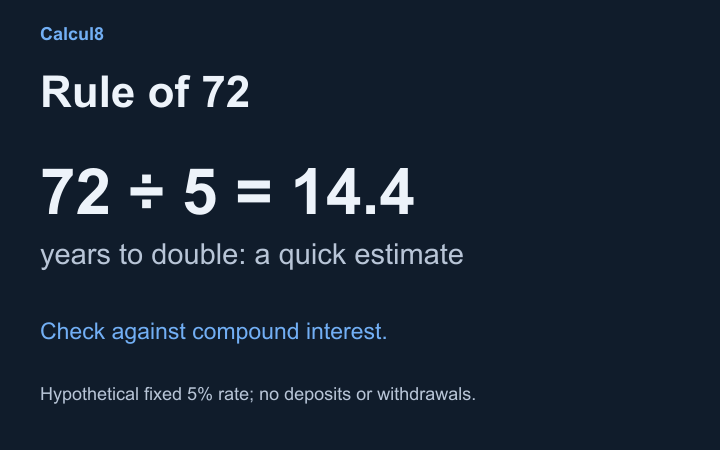
The Rule of 72 estimates how long a lump sum takes to double: divide 72 by the annual percentage rate. At a hypothetical 5% a year, the estimate is 14.40 years. The annual compound-interest formula gives about 14.21 years under the same fixed-rate, no-cash-flow assumptions.
That decimal result is a mathematical growth-curve time. If an account credits interest only at each year-end, the first full year with twice the starting balance is year 15. The calculation and the crediting schedule answer slightly different questions.
Use the Compound Interest Calculator to check a forward projection. The examples below use US dollars, hypothetical constant rates, and no deposits or withdrawals. They are not account offers or investment forecasts.
How to use the Rule of 72
Estimated years to double = 72 ÷ annual percentage rate
Use the percentage number, not its decimal form. For 5%, divide by 5, not by 0.05:
72 ÷ 5 = 14.40 years
The starting amount does not appear in the rule. Under the same fixed rate and compounding assumptions, doubling $500 and doubling $5,000 take the same time. This assumes all interest stays in the balance and you do not add or remove money.
The SEC's teaching guide describes the Rule of 72 as a rule of thumb. It is useful for a quick estimate; it does not identify a suitable investment or guarantee a return.
How long does money take to double at 5%, 7% or 10%?
This comparison assumes annual compounding, a positive constant rate and no cash flows. The formula times are rounded to two decimal places.
| Annual rate | Rule of 72: years | Compound formula: years |
|---|---|---|
| 5% | 14.40 | 14.21 |
| 7% | 10.29 | 10.24 |
| 10% | 7.20 | 7.27 |
At 5%, the rule estimates a slightly longer time than the formula: about 0.19 years, or 2.3 months. At 10%, it estimates a slightly shorter time. The error changes with the rate; the rule is not an exact equation.
These decimal-year results describe the formula between full compounding periods. They are not exact calendar dates or promises about when a bank credits interest. For example, a balance that remains below its target after the 14th annual credit may cross it only when the 15th credit arrives.
The exact compound-interest doubling formula
For a lump sum compounded annually:
A = P × (1 + r)^t
P is the positive starting balance, r is the annual rate as a decimal, and t is time in years. The California Board of Equalization's future-worth lesson explains this compounding expression and the need to match the rate to its period.
To find when the formula reaches twice the starting amount, set A to 2P:
2 = (1 + r)^t
Taking natural logarithms, written as ln, gives:
t = ln(2) ÷ ln(1 + r)
For a 5% annual rate, r = 0.05:
t = ln(2) ÷ ln(1.05) ≈ 14.21 years
This is exact for the stated mathematical model before rounding. Extending the formula to a fractional year assumes a fractional compounding period; actual account terms determine accrual, crediting, day counts and rounding. For the broader formula and examples with new money, read how to calculate compound interest.
Check a $5,000 example in the calculator
Use these settings in the Compound Interest Calculator:
- Initial amount: $5,000.
- Interest rate: 5%, with Rate period set to Yearly.
- Compounding: Yearly.
- Regular money in/out: None.
- Term: start with 14 years and 0 months, then change to 15 years and 0 months.
| Check | Calculation | Ending balance |
|---|---|---|
| After 14 full years | 5,000 × 1.05^14 | $9,899.66 |
| After 15 full years | 5,000 × 1.05^15 | $10,394.64 |
The doubled starting balance is $10,000. The 14-year result is below it; the 15-year result is above it. If interest is credited only annually under this simple model, year 15 is the first complete crediting year that reaches the target.
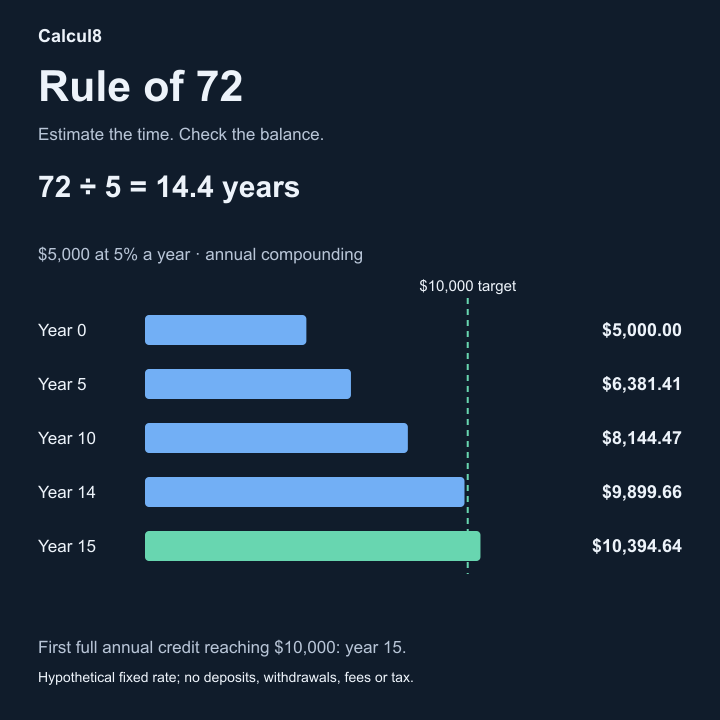
The chart shows selected annual crediting years under this example’s assumptions. Open the full-size chart to inspect the labels.
The calculator keeps full precision while projecting and rounds displayed money to cents. Its graph and CSV let you inspect the path. With these settings, its Time to double line rounds the mathematical duration to 14 years, 2 months. That rounded display is not a bank crediting date or the first full annual credit reaching $10,000. The two ending-balance checks above answer that separate annual-crediting question.
Does monthly compounding change the answer?
It can, when you hold the nominal annual rate fixed. With n compounding periods per year, the corresponding mathematical doubling time is:
t = ln(2) ÷ (n × ln(1 + r / n))
At a 5% nominal annual rate with monthly compounding, n = 12 and the formula gives about 13.89 years. That differs from the 14.21-year annual-compounding curve because the effective annual yield differs.
For worked savings-rate examples, read APY vs interest rate. APY already includes compounding. The CFPB's APY definition makes this distinction. Two scenarios with the same constant effective annual yield have the same full-year lump-sum growth; changing frequency alone does not add another compounding bonus on top of that yield. General takes a nominal rate, so do not enter an advertised APY as a nominal rate and compound it again.
The calculator guide has a controlled compounding-frequency comparison. Match the rate basis before comparing two answers.
When the Rule of 72 is not enough
- Regular deposits or withdrawals: the rule considers growth of the original lump sum alone. Adding money may make the account reach twice its opening balance earlier, but part of that balance is new contributions. The calculator's Time to double line uses the rate alone; use its cash-flow balance projection to assess a plan with deposits or withdrawals.
- A target contribution: if you need the monthly saving required for a goal and deadline, use the Savings Goal Calculator, which assumes end-of-month deposits.
- Zero or negative rates: with no new money, zero interest leaves the balance unchanged and a negative rate reduces it. The positive-rate doubling rule does not apply.
- Variable returns: market gains and losses do not follow a promised constant-rate path. A hypothetical rate is not a prediction.
- Fees, tax and inflation: these examples exclude them. Doubling a nominal cash balance is not the same as doubling purchasing power.
Use the rule for a quick estimate, then check a clearly specified calculation. The result is only as relevant as the rate, cash flows and timing assumptions you choose.