Savings rates
APY vs Interest Rate: What's the Difference?
Learn how APY differs from the interest rate. Compare annual, monthly and daily compounding, then choose the right rate for a savings calculation.
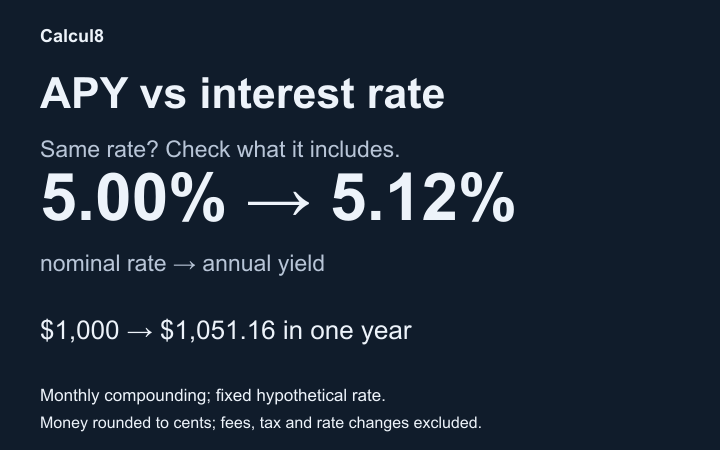
The interest rate and APY describe different parts of savings growth. The interest rate is the annual rate before compounding; the annual percentage yield, or APY, includes its effect. A hypothetical 5% nominal annual rate compounded monthly produces about 5.12% annual yield, rather than exactly 5%.
This guide uses fixed hypothetical rates and US dollars. It explains the arithmetic behind a savings quote; it does not recommend an account or predict future returns. For the broader definition and deposit formulas, read how compound interest works.
APY vs interest rate at a glance
| Term | What it tells you | What to check |
|---|---|---|
| Nominal annual interest rate | The annual rate before the compounding effect | The rate period and how often interest compounds |
| APY | An annualized yield that includes compounding | The stated assumptions and any conditions on the account |
| Interest earned | A dollar amount for a particular balance and period | Deposits, withdrawals, timing and the rate actually applied |
The CFPB's Regulation DD definitions distinguish the interest rate from APY on this basis. APY is a percentage, not an amount of money. A larger balance can earn more dollars at the same yield.
How to calculate the effect of compounding
For a fixed nominal annual rate and equal compounding periods, with all interest retained:
Annual yield = (1 + r / n)^n − 1
Here, r is the nominal annual rate as a decimal and n is the number of compounding periods per year. Multiply the answer by 100 to express it as a percentage.
At a 5% nominal annual rate compounded monthly, r = 0.05 and n = 12:
((1 + 0.05 / 12)^12 − 1) × 100 ≈ 5.12%
This is a simplified fixed-rate example, not a complete implementation of bank disclosure rules. The CFPB's APY calculation appendix covers annualization, account terms and special cases such as variable and tiered rates. A displayed APY can also be rounded, so it need not reveal the exact underlying nominal rate.
What happens to $1,000 at a 5% interest rate?
Keep the nominal annual rate at 5%, start with $1,000, leave all interest in the balance for one year, and make no deposits or withdrawals. Changing only the compounding frequency gives:
| Compounding | Annual yield, rounded | Interest earned | Ending balance |
|---|---|---|---|
| Yearly | 5.00% | $50.00 | $1,050.00 |
| Quarterly | 5.09% | $50.95 | $1,050.95 |
| Monthly | 5.12% | $51.16 | $1,051.16 |
| Daily, 365 periods | 5.13% | $51.27 | $1,051.27 |
Each balance uses 1,000 × (1 + 0.05 / n)^n. Calculations retain full precision; money is rounded to cents and yields to two decimal places for display. Fees, taxes, inflation and rate changes are excluded.
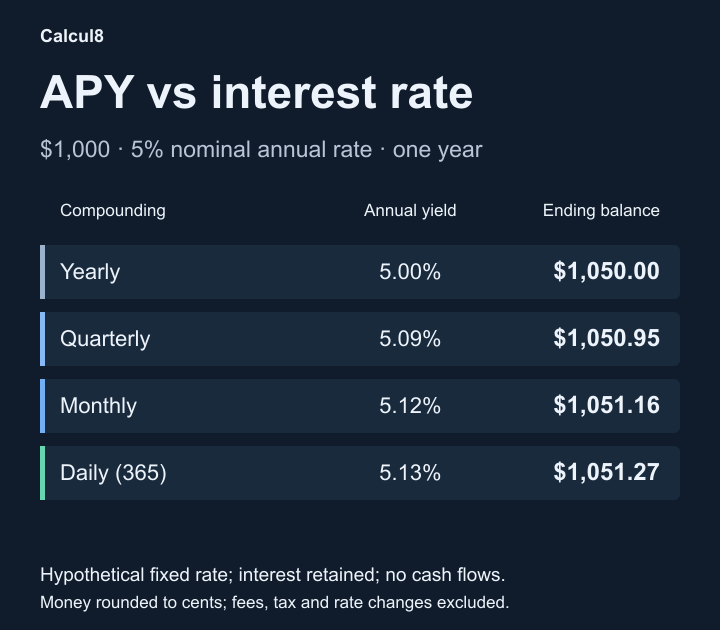
Open the full-size comparison to inspect the figures. This table holds the nominal rate fixed. If two scenarios instead have the same constant APY, they have the same full-year lump-sum growth under the same assumptions; more frequent compounding does not add a second yield bonus.
Which rate should I enter in the calculator?
The Compound Interest Calculator takes a nominal rate, its rate period and a separate compounding frequency. APY already includes compounding: entering it as a nominal rate and compounding it again can overstate growth.
To reproduce the monthly row above, choose US dollars and enter:
- Initial amount: $1,000.
- Interest rate: 5%, with Rate period set to Yearly.
- Compounding: Monthly.
- Term: 1 year and 0 months.
- Regular money in/out: None.
The estimated future balance is $1,051.16, interest earned is $51.16, and the effective annual rate is 5.12%, rounded. For the other rows, change only Compounding to Yearly, Quarterly or Daily (365/yr).
If a quote gives only 5% APY, the simple one-year calculation for an unchanged $1,000 balance is 1,000 × 1.05 = $1,050.00, assuming that yield applies for the full year and interest stays in the balance. That differs from the monthly row's 5% nominal rate. Get the underlying nominal rate and compounding terms before using them in the calculator; it does not accept APY as a separate input or reverse-solve a quoted APY into a bank's exact rate.
Adding deposits changes the question. Part of the final balance is your new money, and the date it arrives affects the interest it earns. Use the calculator's stated cash-flow assumptions, or the Savings Goal Calculator when you need a monthly contribution for a target.
Does daily compounding mean interest is paid daily?
Not necessarily. Accrual concerns interest building up, compounding concerns interest earning further interest, and crediting concerns when interest is posted to the account. An account can compound daily and credit monthly. A monthly credit does not, by itself, mean monthly compounding.
The CFPB's account-disclosure rules address compounding and crediting frequencies separately from other account conditions. Check the actual account terms, including balance requirements, fees and rate changes. These can affect your outcome beyond the comparison of two percentages.
The Daily Compound Interest Calculator offers its own calendar schedules, reinvestment and cash-flow options. It is a scenario model, not a replica of every bank's accrual, statement or crediting rules.
Is a higher APY always the better choice?
APY helps compare interest growth, but it does not describe the whole account. Check whether rates can change, whether a promotional period ends, which balance earns the rate, what fees apply and when you can access the money. Our examples hold those complications outside the model.
For a quick estimate of how a fixed yield relates to doubling time, read the Rule of 72 guide, including its distinction between a mathematical growth curve and actual crediting dates. Match the rate basis and assumptions before comparing any two results.
If two tools still show different balances, use our guide to comparing compound-interest calculator results to check deposit timing, term conventions and other model assumptions.